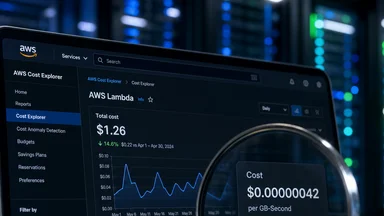
At 4:17 AM on a Tuesday, the first billing alarm fires. The solo DevOps engineer for a 50-person SaaS firm—let's call him Alex—wakes to a Slack notification: his monthly VPS bill has breached $8,500. Twelve instances, all provisioned manually, each one a monolithic app server. No auto-scaling, no load balancer, no container orchestration. Just a growing pile of virtual machines and a credit card that auto-pays every month. This is the $100,000-a-year VPS trap, and it's far more common than you'd think.
The $100k VPS Trap: When Convenience Costs the Farm
Alex's setup began innocently enough. A single VPS for the production app, a second for staging, a third for a database. The company grew, customers signed up, and traffic increased. The response was simple: upgrade to a larger instance, then add another, then another. Within two years, Alex managed twelve VPS instances across two regions, all from a major cloud provider, paying list price with no contract discount.
The monthly bill of $8,500—roughly $102,000 annually—represents two junior engineer salaries at many companies. But Alex is the only infrastructure person. He handles deployments, patching, backups, monitoring, and incident response. The VPS model, which promised simplicity, has become a time sink and a financial leak. There's no scaling plan beyond vertical upgrades: when CPU hits 80%, he moves to the next tier. When disk fills, he attaches another volume.
Cloud provider lock-in without a discount agreement means every gigabyte of egress, every snapshot, every static IP carries a premium. Alex's company is bootstrapped, with revenue per customer barely covering hosting. The break-even analysis shows an 18-month runway at the current burn rate. Something has to change.
Why VPS Still Seduces the Solo Practitioner
VPS hosting retains an almost nostalgic appeal for solo engineers. The control panel is familiar, the one-click deploy is seductive, and root access feels like true ownership. For engineers who cut their teeth on shared hosting, a VPS represents a natural upgrade—more power, same mental model. You SSH in, install packages, configure nginx, and you're done.
But that familiarity masks a dangerous inertia. Learning Kubernetes or serverless architectures requires a significant upfront time investment—weeks of study, trial clusters, and debugging. For a solo engineer already firefighting production issues, that learning curve feels impossible. The credit card autopay masks the bleeding; the bill comes, it's paid, and the cycle continues.
There's also a cultural comfort: VPS instances are the default choice for countless tutorials, blog posts, and starter stacks. They're the path of least resistance. But as the infrastructure grows, the cost of convenience compounds. Alex's 12 instances are each a snowflake—configured manually, patched ad hoc, and backed up via a cron job that nobody has tested in months.
The Hidden Costs Beyond the Invoice
The $8,500 monthly invoice is only the visible tip. Alex spends roughly 10 hours per week on manual OS patching, applying security updates across a dozen instances, each with its own package manager quirks. That's 40 hours a month—a full work week—doing work that could be automated. At a conservative billing rate of $150/hour, that's $6,000 in opportunity cost monthly, pushing the true cost of the setup past $14,000 per month.
No auto-scaling means the fleet is overprovisioned for average load and underprovisioned for spikes. Alex's instances idle at roughly 30% CPU utilization most of the time, paying for capacity he doesn't need. When traffic spikes—a product launch, a viral post—response time degrades, and he manually spins up a new instance, hoping the database can handle the connection surge.
Database backups run via a shell script launched by cron. There's no disaster recovery testing; the backup files sit on a secondary volume in the same data center. SSL certificate renewals fail at 3 AM on a Sunday, taking down the customer-facing app until Alex wakes up. Network egress fees surprise at month-end—a single data-heavy customer can add hundreds of dollars in unexpected charges. These hidden costs erode trust in the hosting model and distract from product development.
For a deeper look at how infrastructure decisions compound, see our piece on the platform tax in managed services.
The Arithmetic of Unsustainability
Let's run the numbers on Alex's setup. At $102,000 per year, the hosting cost alone equals the fully-loaded salary of two junior engineers. But Alex's company has only 50 employees and modest revenue. Industry benchmarks for SaaS companies suggest infrastructure costs should run between 5% and 15% of revenue. If Alex's company does $1 million in annual recurring revenue, that $102,000 represents over 10%—at the high end, but not insane. If ARR is $500,000, that's over 20%, which is unsustainable.
Growth exacerbates the problem. Scaling the current model means either adding more VPS instances (linear cost increase) or refactoring the application to be more efficient (lumpy time investment). The VPS unit cost is flat—each new instance costs roughly the same as the last—but operational complexity grows super-linearly. More instances mean more patching, more monitoring, more failure modes.
The break-even analysis is sobering: at current burn, the company has roughly 18 months of runway before hosting costs consume the entire infrastructure budget. Alex needs to either reduce cost or increase revenue. Since he controls the former, the path is clear: migrate to a more efficient architecture. But the migration itself requires time he doesn't have, creating a classic bootstrap dilemma.
The Hidden Cost of Manual Operations: A Deeper Dive
Beyond the obvious time sink, manual patching introduces risk. Each of Alex's 12 instances runs a slightly different OS version—some Ubuntu 20.04, some 22.04, one CentOS 7 that he hasn't migrated yet. Patching requires adapting commands per OS, and a missed update can lead to a security breach. In 2023, a known vulnerability in a popular web server affected unpatched instances; Alex spent a full weekend applying emergency patches across his fleet. That emergency response cost him not just time but also sleep and focus on product development.
Configuration drift is another hidden cost. Each instance has been tweaked over time—custom nginx settings, different firewall rules, unique cron jobs. When Alex needs to replicate an environment for a new customer, he often spends hours reverse-engineering an existing instance. This snowflake problem makes scaling and disaster recovery nearly impossible. If a primary instance fails, spinning up a replacement requires manual reconfiguration, leading to hours of downtime.
Monitoring is also fragmented. Alex uses a mix of tools: a basic Nagios setup for uptime, custom scripts for disk usage, and a third-party service for application performance. None of these are integrated, so he spends time each morning checking multiple dashboards. A unified monitoring solution like Prometheus with Grafana could consolidate everything, but setting it up feels like another project he cannot prioritize.
Security compliance is another concern. If Alex's company handles payment data, they may need to comply with PCI DSS standards. Manual patching and ad hoc configurations make audits painful. A containerized environment with immutable infrastructure would simplify compliance by ensuring every deployment is identical and auditable. The cost of non-compliance—fines or loss of business—could dwarf the VPS bill.
Three Concrete Alternatives That Slash Cost
There is no single silver bullet, but several viable paths can reduce Alex's monthly bill by 60% or more while improving reliability. The first is migrating to a single bare-metal server with Docker Swarm. Bare-metal from providers like Hetzner or OVH costs roughly $60–$120 per month for a machine with 64 GB RAM and 8 cores—comparable to a mid-range VPS but without the virtualization overhead. Docker Swarm provides orchestration without the complexity of Kubernetes; it's learnable in a weekend.
Second, adopting a PaaS like Fly.io eliminates server management entirely. Fly.io offers auto-scaling, global load balancing, and per-container billing. For Alex's workload—a monolithic Rails app with a PostgreSQL database—the estimated monthly cost would be around $2,000–$3,000, a 65–75% reduction. The trade-off is less control over the runtime environment and potential vendor lock-in at the PaaS level. However, Fly.io's pricing is transparent and includes egress, which eliminates surprise charges. A counter-argument is that the lock-in risk is real: if Fly.io changes its pricing model or discontinues features, migrating again could be costly. But for a bootstrapped company, the immediate cash savings may outweigh that risk.
Third, spot instances from any major cloud provider can handle batch workloads at roughly 70% discount. Alex could move non-critical background jobs—report generation, data exports, email delivery—to spot instances, saving perhaps $500–$1,000 per month. This approach requires fault-tolerant job design, but it's a low-risk first step. For example, using AWS Spot Instances with a simple retry mechanism can cut costs for batch processing significantly. However, spot instances can be terminated at any time, so they are not suitable for stateful or latency-sensitive workloads.
For a related discussion on hidden infrastructure costs, see bundle bloat analysis in frontend frameworks.
The Migration Playbook for a Solo Engineer
Migrating from a 12-instance VPS sprawl to a leaner architecture is daunting, especially for a solo engineer. A phased approach reduces risk and allows course correction. Phase 1: containerize the simplest stateless service. Alex's app has a background job worker that processes email queues. It's stateless, so it's the perfect candidate. He wraps it in a Docker container, sets up a local registry, and deploys it to a single Docker Swarm node. This step alone validates the container pipeline and gives confidence.
Phase 2: move the database to a managed PostgreSQL service. Managed databases handle backups, replication, and patching automatically. Providers like Aiven or Crunchy Bridge offer plans starting around $50–$100 per month for a modest database, far less than the cost of a dedicated VPS for the database plus Alex's manual maintenance time. This step alone can save 5–10 hours per week. However, there is a trade-off: managed databases often charge for storage and egress, and migrating a large dataset can be time-consuming. Alex must also consider data residency requirements if his customers are in specific regions.
Phase 3: set up CI/CD with GitHub Actions and Kamal. Kamal is a deployment tool that uses Docker containers and SSH to deploy to remote servers. Alex can define a simple deployment pipeline that builds, tests, and deploys the containerized app to a bare-metal server. This eliminates manual SSH sessions and reduces deployment errors. A counter-argument is that Kamal is relatively new and may lack features of mature tools like Ansible or Terraform. However, for a solo engineer, its simplicity is a virtue.
Phase 4: retire one VPS per week. Alex creates a checklist: move the service, update DNS, monitor for errors, then terminate the instance. Retiring one per week keeps the pace manageable and provides early feedback. Phase 5: implement cost alerts and a budget dashboard. Using a tool like Grafana Cloud's free tier, Alex sets up dashboards that show hourly cost by service, with alerts when spending exceeds thresholds. This visibility prevents future bill shocks.
The Trade-off: Time Investment vs. Monthly Savings
The migration effort is real. Alex estimates 40–60 hours of focused work over two months: learning Docker Swarm, refactoring the app for containers, setting up CI/CD, and testing the new infrastructure. That's roughly one week of full-time work. For a solo engineer already stretched thin, finding that time is the hardest part. It might mean delaying a feature release or working weekends temporarily.
But the payoff is substantial. After migration, the monthly bill drops from $8,500 to roughly $2,000–$2,500, saving $6,000–$6,500 per month. Ongoing maintenance drops from 10 hours per week to about 2 hours, freeing 8 hours weekly for product work. The breakeven on time investment is about 4 months—after that, every hour saved is a gift.
Of course, the migration is not without risk. Containerization can introduce subtle bugs in stateful services. Bare-metal servers require more careful capacity planning than VPS—you can't resize them with a click. And PaaS lock-in is a real concern: if Fly.io raises prices or changes terms, migrating again is painful. Reasonable people disagree on whether the complexity reduction of PaaS outweighs the lock-in risk. Some engineers prefer to stay with raw VPS and use automation tools like Ansible to reduce manual work, which can cut costs without a full migration. Others argue that moving to a single bare-metal server with Docker Swarm is the sweet spot for a solo engineer: low cost, full control, and moderate complexity.
For a cautionary tale on infrastructure trade-offs, see this database bottleneck case.
Alex's story is not unique. Thousands of solo DevOps engineers are running similar setups, paying for convenience they can no longer afford. The path out requires a deliberate investment of time, a willingness to learn new tooling, and a clear-eyed view of both the costs and the trade-offs. But the alternative—continuing to burn $100,000 a year on unsustainable VPS hosting—is not a viable long-term strategy. The alarm clock is ringing. It's time to answer.