In the early 1980s, American astronomy faced a quiet crisis. The National Science Foundation's budget for astronomical sciences had been flat for several years, and inflation was steadily eroding its purchasing power. At the same time, the cost of building new telescopes was rising faster than inflation, driven by demand for larger mirrors and more complex instruments. Major observatories like Kitt Peak and Palomar were already over budget and behind schedule. The community needed a cheaper way to build big telescopes, or the next generation of discovery would simply not happen.
This article traces how that budget squeeze forced a fundamental rethinking of telescope design, leading to innovations—segmented mirrors, alt-azimuth mounts, and fixed-price contracts—that enabled a string of transformative projects. It is a story of constraint breeding creativity, and of how a single funding crisis reshaped the entire field.
The NSF Budget Crunch That Reshaped American Astronomy
By 1982, the NSF's Division of Astronomical Sciences was funding roughly the same number of grants as a decade earlier, but each dollar bought less. The cost of building and operating telescopes had grown faster than the agency's overall budget, which was itself growing slowly after adjusting for inflation. According to a 1983 internal NSF memo, the division's purchasing power for new instrumentation had dropped by roughly 30% since the mid-1970s.
Major projects suffered. The 4-meter Mayall telescope at Kitt Peak, completed in 1973, had cost about $10 million (in 1980 dollars). By 1982, plans for an 8-meter-class telescope—the next logical step—were estimated at $50 million or more. That was five times the cost of a 4-meter, but only twice the light-collecting area. The cost per square meter of mirror area had more than doubled. Some NSF program officers began to ask whether the traditional approach of casting a single large mirror and mounting it on a heavy equatorial fork was sustainable.
The problem was not unique to the United States. European and Japanese observatories faced similar pressures, but the US had the largest fleet of telescopes and the most to lose. In 1983, NSF division director Richard Green convened a series of workshops to explore alternatives. The message from the community was clear: either find a way to build telescopes for half the price, or accept that the US would fall behind in observational astronomy.
How a Single Memo Forced a Rethink of 'Big Glass'
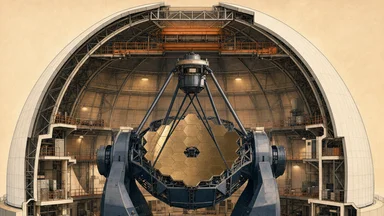
In 1982, Richard Green, then an NSF program officer, circulated a memo that would become legendary in telescope design circles. Titled "Cheaper Telescopes for the 1990s," the memo argued that the traditional approach—casting a single, thick monolithic mirror and mounting it on a massive equatorial structure—was no longer viable. Green proposed two radical ideas: break the mirror into smaller segments, and replace the equatorial mount with a simpler alt-azimuth design.
The memo drew on work that was already underway. At the University of Arizona, astronomer Roger Angel had been experimenting with spin-cast honeycomb mirrors, which used a rotating furnace to produce a lightweight, stiff structure. Meanwhile, engineers at the Lawrence Livermore National Laboratory had developed segmented-mirror technology for military surveillance satellites. Green argued that combining these ideas could cut the cost of an 8-meter telescope by a factor of two or more.
The initial reaction was skeptical. Many astronomers worried that segmented mirrors would be impossible to align precisely, and that alt-azimuth mounts would introduce tracking errors that could not be corrected. But Green's memo had an impact. It framed the problem not as a technical challenge but as a funding imperative: if the community wanted a next-generation telescope, it had to accept a different design. Within a year, the NSF had funded a study group to evaluate the feasibility of segmented-mirror telescopes.
The Birth of the Segmented-Mirror Revolution
Roger Angel's work at the University of Arizona's Steward Observatory Mirror Lab was crucial. Angel had developed a method for casting mirrors in a rotating furnace, which produced a honeycomb structure that was both lightweight and stiff. The honeycomb design reduced the mirror's mass by roughly 80% compared to a solid blank of the same diameter, making it easier to support and cheaper to transport. But even with this innovation, casting a monolithic 8-meter mirror was still expensive and risky.
The segmented-mirror approach offered a different path. Instead of one large mirror, the telescope would use many smaller hexagonal segments, each cast and polished individually, then aligned to act as a single surface. The Keck Observatory, which began construction in 1985, adopted this design for its two 10-meter telescopes, each using 36 hexagonal segments. The cost per square meter of mirror area was roughly one-third that of a monolithic 8-meter design, according to some estimates.
The NSF funded Keck I as a 'test bed' for the new technology, committing roughly $70 million (in 1985 dollars) to the project. The gamble paid off. Keck I saw first light in 1990 and was operating at full capacity by 1993. The segmented design proved stable and alignable, and the telescopes achieved image quality comparable to the best monolithic instruments. Keck's success validated the concept and opened the door for other segmented projects.
Adopting Alt-Azimuth Mounts to Slash Dome Costs
Traditional equatorial mounts keep the telescope's axes aligned with the Earth's rotation, simplifying tracking but requiring massive steel structures to support the weight. An alt-azimuth mount, by contrast, moves the telescope in altitude (up-down) and azimuth (left-right), which is mechanically simpler but requires computer-controlled tracking to follow celestial objects. The trade-off was that computers could correct for the rotation of the field of view in real time.
The first large telescope to use an alt-azimuth mount was the 6-meter Bolshoi Teleskop Alt-azimutalnyi (BTA) in the USSR, which saw first light in 1976. The BTA's mount was about 40% lighter than an equivalent equatorial design, reducing the cost of both the mount and the dome. However, the telescope suffered from tracking problems and never achieved its full potential. The lessons were clear: the mount itself worked, but the control system needed to be more sophisticated.
In 1984, the NSF's workshop on future telescope designs formally endorsed alt-azimuth mounts for all new large projects. By the time the Gemini telescopes were designed in the early 1990s, the technology had matured. Gemini's 8.1-meter telescopes used alt-azimuth mounts that cost roughly half what an equatorial design would have, according to project documents. The savings allowed the project to fit within its budget cap, which was set at $184 million (in 1990s dollars) for both telescopes.
The 1986 Decadal Survey Locked in Austerity Design
The 1986 decadal survey of astronomy, chaired by John Bahcall, was the first to explicitly incorporate cost constraints into its recommendations. The survey's top priority was the Gemini 8-meter telescopes, a pair of instruments that would be built in the Northern and Southern Hemispheres. But the committee set a firm budget cap: $184 million total, with no cost overruns allowed. This forced the project to use fixed-price contracts with industry, a departure from the cost-plus model that had dominated earlier projects.
The Gemini design borrowed heavily from Keck. It used segmented mirrors (though with 8.1-meter monolithic segments, not hexagons) and alt-azimuth mounts. The project also required a 50% cost share from international partners, a model that had been used on smaller projects but never on a major telescope. The partners—the United Kingdom, Canada, Chile, Argentina, and Brazil—each contributed resources in exchange for observing time.
The fixed-price contracts were controversial. Some engineers argued that they encouraged cutting corners, and indeed Gemini faced delays and cost overruns that strained the partnership. But the project was completed within its overall budget, and both telescopes began operations in the early 2000s. The decadal survey's insistence on cost discipline set a precedent that would influence all subsequent large projects.
Legacy: Cheaper Telescopes Enabled the Sloan Digital Sky Survey
The Sloan Digital Sky Survey (SDSS) was a different kind of project. Instead of a general-purpose telescope, SDSS was designed from the start for a single purpose: to map a large fraction of the sky in multiple colors and to obtain spectra of millions of galaxies and quasars. The telescope itself was a 2.5-meter modified Ritchey-Chrétien design, modest in size but optimized for wide-field imaging. The total project cost was about $85 million (in 1990s dollars), roughly 10% of the Hubble Space Telescope's price tag.
The SDSS telescope used an alt-azimuth mount and a simple steel structure, keeping costs low. The key innovation was its multifiber spectrograph, which could observe 640 objects simultaneously. This instrument piggybacked on the cheap mount, proving that a focused survey could produce enormous scientific returns without a massive infrastructure. The first SDSS data release, in 2001, contained images of 200 million celestial objects and spectra of 600,000 galaxies. As of the early 2020s, SDSS data remains one of the most-cited resources in astronomy.
The SDSS demonstrated that the lessons of the 1980s budget squeeze could be applied even to modest projects. By focusing on a clear scientific goal and using off-the-shelf technology, the SDSS team maximized science per dollar. The project's success encouraged funding agencies to consider similar 'frugal engineering' approaches for future surveys.
Lessons for Today's Giant Telescope Projects
Today's largest telescopes—the Extremely Large Telescope (ELT) at 39 meters, the Thirty Meter Telescope (TMT), and the Giant Magellan Telescope (GMT)—all use segmented mirrors. The ELT's primary mirror will consist of 798 hexagonal segments, each 1.4 meters across. The TMT will use 492 segments. The GMT uses a different approach, with seven 8.4-meter monolithic segments, but the principle is the same: smaller pieces are cheaper to cast and transport.
The NSF has learned from the 1980s. The agency now demands cost controls from the earliest stages of a project. The US Extremely Large Telescope Program, which aims to fund a share of the TMT and GMT, is budgeted at roughly $1.6 billion, with strict milestones and penalties for delays. International partnerships are standard: the ELT is a European project with contributions from several countries, while the TMT involves Canada, India, Japan, and China.
But the lessons are not all positive. The fixed-price model that worked for Gemini has been harder to apply to the ELT and TMT, which are pushing the limits of engineering. Both projects have faced cost overruns and schedule delays, and the TMT has been stalled by political disputes over site selection. The 1980s squeeze forced innovation, but it also created a culture of underfunding that can lead to tension between scientific ambition and fiscal reality.
Without the budget squeeze of the early 1980s, it is doubtful that today's giant telescopes would exist in their current form. The crisis forced astronomers to accept new technologies and new ways of managing projects. The result was a generation of telescopes that delivered more science per dollar than anyone had thought possible. But the trade-offs—fixed-price contracts, international dependencies, and a reluctance to fund purely exploratory instruments—are still being felt today.
Counter-Arguments: The Risks of Austerity-Driven Design
While the budget squeeze spurred valuable innovation, not all astronomers agree that cost-cutting was always beneficial. Some argue that the emphasis on fixed-price contracts and international partnerships sometimes compromised scientific performance. For example, the Gemini telescopes, though successful, faced criticism for their limited instrument suite compared to earlier monolithic telescopes. The fixed budget meant that fewer instruments could be built, reducing the range of science each telescope could do.
Another concern is that the focus on cheap designs may have discouraged riskier, potentially more rewarding technologies. The 1980s squeeze made funding agencies risk-averse, favoring proven approaches over experimental ones. This may have delayed the adoption of adaptive optics, which required significant investment before it became practical. Some astronomers argue that a more balanced funding model, with room for both cost-effective and ambitious projects, would have served the community better.
Trade-offs also exist in the choice between segmented and monolithic mirrors. Segmented mirrors require complex alignment systems that can fail, and they introduce diffraction effects from the gaps between segments. For some applications, such as high-contrast imaging of exoplanets, a monolithic mirror may be superior. The GMT's approach of using large monolithic segments tries to capture the best of both worlds, but it comes at a higher cost per square meter. These trade-offs continue to be debated as new projects are planned.
International partnerships, while spreading costs, also introduce management challenges. The Gemini project's partnership faced tensions over scheduling and instrument funding, and the TMT has been delayed by disagreements with local communities over site selection. These issues highlight that cost-saving measures can have hidden costs in terms of complexity and delays. The 1980s squeeze taught astronomers to be frugal, but it also taught them that frugality requires careful management of trade-offs.